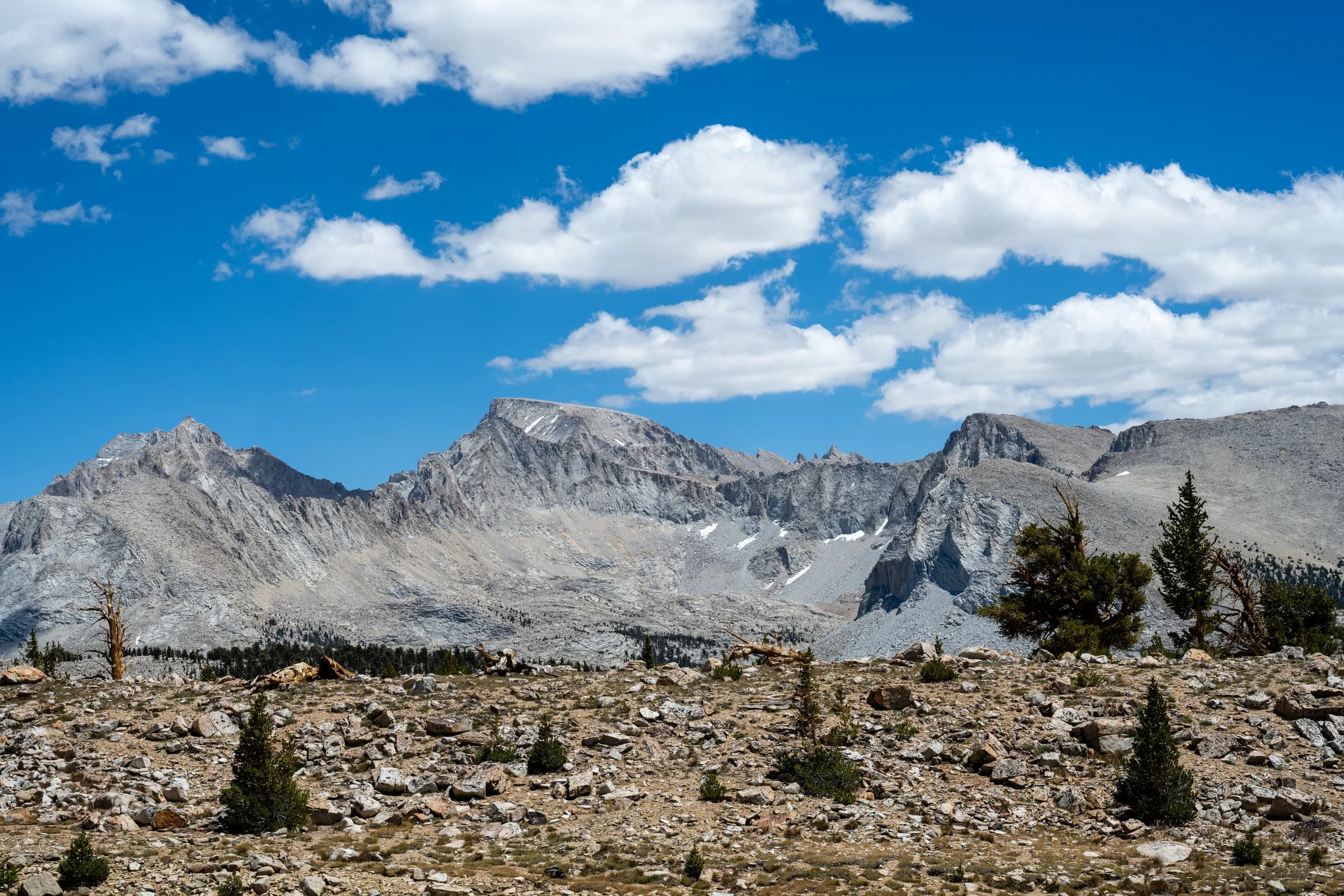
Walking the John Muir Trail in sections took me eight years. Over those years I got my sleep apnea under control, lost more than forty pounds, gave up on ultralight, and found boots that fit. This chapter is about what I learned along the way.
The mountains are calling
Every year before a section, I worried I was not prepared enough, some years more than others. I would read Andrew Skurka's pages on hazardous High Sierra creek crossings and study the "train" method for fording a river three across. I bought crampons for the snow still on Forester's north face after a long podcast with Ned Tibbits. And I would still lie awake turning Rock Creek, Tyndall Creek, and Bubbs Creek over in my head. The worry never fully left. But every year, the mountains were calling, and every year I went.
The worry never fully left. But every year, the mountains were calling, and every year I went.
Maps and apps
Carry a paper map, and know how to use it with a compass. I carried Tom Harrison's John Muir Trail Map-Pack and Elizabeth Wenk's John Muir Trail: The Essential Guide, and there were days I needed them.
FarOut (previously called Guthook) came in handy. Its team, like Erik the Black and Lizzie Wenk, hikes the trail and checks its data on the ground. AllTrails maps failed me multiple times on my High Sierra Trail hike. It took us off trail, and we had to resort to paper maps and compass to figure out where we were. Apps built on publicly available map data and crowdsourcing are great for city and front-country hiking, but weak in the backcountry. AllTrails+ (formerly Pro) custom maps are a useful addition alongside FarOut if you can carefully curate the map yourself and not rely on others.
What my body taught me
The trail did not begin at a trailhead for me; it began in a sleep doctor's office. At my worst I was 5'9" and 206 pounds, wiped out every day by 2 p.m., with no energy to focus, let alone exercise. I once fell asleep at the wheel driving south on I-680 and woke a second later, scared enough to finally see a doctor. A sleep study measured an AHI of 95, very severe apnea; the doctor called me a person who was "walking dead."
Getting better was the real training for the Sierra. A septoplasty and a CPAP machine gave me my first real night's sleep in years, and with that came the energy to join a gym and start on small-group strength work. In a year I dropped to about 185, then, with a dental appliance and intermittent fasting, down to 162 by the time I hiked the High Sierra Trail. I still remember how happy my knees felt at that weight. On the trail the dental appliance keeps me at an AHI of around 15, down from 95. That is mild-to-moderate apnea instead of very severe, and enough that apnea no longer catches up with me on day three or four. I have now strung together thirteen days in the High Sierra, re-energized and ready to hike day after day. Backpacking with sleep apnea is possible, but I had to fix my health and fitness first to get there.
On the 2021 section my watch warned me that my blood oxygen was low, 93%, and noted it was measured at high altitude. At 11,000–13,000 feet, blood oxygen for people who live at sea level can dip into the low-to-mid 80s during sleep or on a climb, even without apnea. Apnea and altitude were stacking on top of each other for me. On Bighorn Plateau in 2025 I also had lungs still inflamed from COVID-19 a month earlier, and I could barely climb for a minute at a time. Both together nearly ended my hike there.
The gear weight I chose to carry
For a couple of years I chased ultralight gear. I got my base weight down from 26–27 pounds to 19, not truly ultralight, but a real cut. I swapped my REI Magma 10 for a quilt, my wide pad for a narrow one, my tent for a sub-two-pound mesh shelter, and my pack for a sub-two-pound Gossamer Mariposa. It all worked beautifully on short, warm trips under thirty pounds.
Then, on a five-day loop through the High Sierra Camps with my pack pushing thirty-five pounds and a night above 10,000 feet at Vogelsang, it fell apart. The mesh tent and the quilt let a cold draft in no matter how I strapped them; I missed my wide pad and my hands kept sliding off the edge; and the Mariposa, fantastic to thirty pounds, transferred that heavier load so poorly to my hips that I was taking the pack off every mile to rest my shoulders. I started undoing my own changes and ended up on an Aarn Featherlite Freedom Bodypack, much heavier, and it carries the weight better.
Conventional wisdom says cut every possible ounce, that when your base weight hits some magic fraction of your body weight your life gets better. Twenty percent of your body weight: for one night? For a week? For rainy weather? For river crossings? I would rather carry a few more pounds on a pack that spreads the load evenly and lets me hike painlessly than a few pounds less on one that hurts me by the end of the day. Hike your own hike, and if that means a heavier pack, so be it.
The boots that gave me the trail back
For years I fought my own feet: eight different boots, a burning pain on the outside of my foot, cortisone shots, and a podiatrist who told me to find a new hobby. Then I found Kevin Leahy, an artisan who had apprenticed under Austrian and German shoemakers and earned a degree in prosthetics, and who would watch you walk barefoot to read your gait before he ever touched leather. His custom boots made backpacking a joy again; along with the strength training, they were a big part of my recovery. On the Yosemite section in 2022, my first hike in his boots, I recorded a voice message to him as I climbed Donohue Pass and sent it from the summit. Kevin passed away, and I never did record the podcast I kept meaning to make with him. I still lace his boots for every hike. They have over 500 miles on them now, are fully set to my feet, and show little wear.
How the trail followed me home
After each section, I feel the calm from the trail for months. The mountains were still calling when I finished; I just answer differently now.